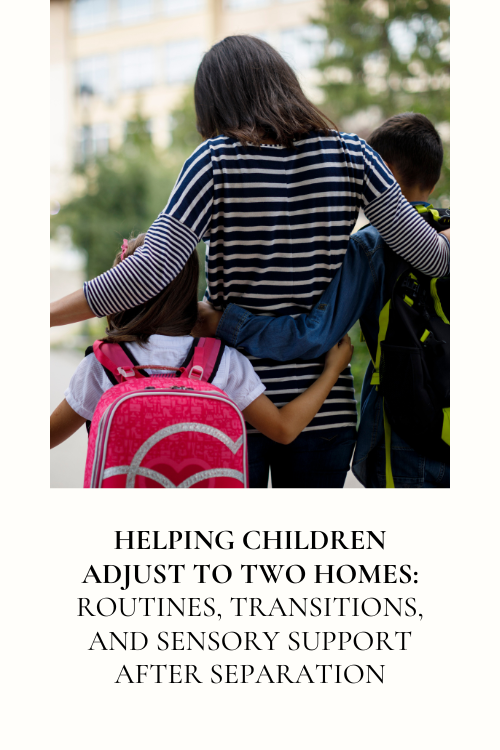
 A child does not need two identical homes after a separation. What helps most is knowing what will happen next, trusting that both caregivers will meet their needs, and having simple routines that travel with them. Predictable schedules, calm handoffs, familiar objects, and age-appropriate choices can turn a confusing two-home arrangement into a manageable new normal.
Separation can bring many emotions. Children may show them directly or through sleep changes, clinginess, irritability, withdrawal, or poor concentration. These reactions do not automatically indicate a disorder; respond with steadiness.
For more on this topic, check out the full Tough Times collection
Key Takeaways
- Children generally adjust better when the schedule is clear and caregivers keep a few core routines consistent.
- A short, neutral handoff is often easier than a long or emotionally charged goodbye.
- Comfort items and sensory-friendly choices can help some children regulate, but not every child needs occupational therapy.
- Adults should keep legal, financial, and relationship conflict away from the child.
- Parenting plans should fit the child’s age, school, activities, health needs, and travel realities; family law varies by state.
- Persistent or severe distress deserves support from an appropriate pediatric, mental-health, school, or therapy professional.

Start With the Message a Child Needs to Hear
Children often wonder whether they caused the separation, whether they will lose a parent, and what else is about to change. A clear message can reduce that uncertainty:
“This is an adult decision. It is not your fault. We both love you, and you will be cared for in both homes.”
Keep the explanation truthful but limited to what the child can understand. A preschooler needs concrete information about tonight and tomorrow. A school-age child may want to know how school, sports, and holidays will work. A teenager may care most about transportation, privacy, friendships, and having some voice in the schedule.
Avoid sharing allegations, legal strategy, money disputes, or intimate details. Children should not become messengers, investigators, confidants, or judges. If they ask a question you cannot answer yet, it is fine to say, “We are working that out, and we will tell you when we know.”
Build Predictability Without Demanding Two Identical Homes
Consistency is useful, but perfect uniformity is neither realistic nor necessary. One home may be quieter; the other may include stepsiblings, pets, or a different bedtime rhythm. Focus on a small set of anchors that support the child’s functioning.
Choose three to five core routines
Good candidates include:
- a regular bedtime window and wind-down sequence;
- medication and health-care instructions;
- school-night homework expectations;
- rules for devices and online access;
- how the child contacts the other caregiver; and
- a dependable plan for exchanges.
Write down details that are easy to misunderstand. A shared calendar can show overnights, pickups, school events, appointments, and activities. For younger children, use pictures or colors. Instead of saying, “You’re going to Dad’s on the second and fourth weekends,” show where the child will sleep for the next several nights.
Create a portable routine
A routine can travel even when the household changes. The same bedtime song, morning checklist, or after-school snack can create continuity. Duplicate essentials can make packing less stressful. Let the child choose whether a comfort object travels, and never use it to monitor the other home.

Make Transitions Boring—in a Good Way
Handoffs are difficult when they carry adult tension. The goal is not a ceremonial goodbye; it is a safe, predictable transfer.
Before the exchange
Give a calm reminder: “After soccer, you’re going to Mom’s. Your blue bag is ready.” Help younger children pack, but gradually give older children responsibility for a checklist. Share necessary information directly with the other caregiver rather than through the child.
If face-to-face exchanges repeatedly lead to arguments, a school pickup or another neutral transition may reduce strain when permitted by the parenting plan. Safety concerns require individualized legal advice and, when appropriate, help from local professionals or authorities—not generic co-parenting tips.
During the exchange
Keep greetings and goodbyes warm and brief. Do not quiz the child, inspect their belongings, criticize what they are wearing, or negotiate the schedule at the curb. A useful script is: “Have a good time. I’ll see you Tuesday after school.”
Children sometimes cry at a handoff and settle soon afterward. A tearful goodbye does not by itself prove that the schedule is harmful or that the other home is unsafe. Notice patterns over time and stay curious rather than drawing instant conclusions.
After arrival
Allow a decompression period. Some children want connection; others need a snack, movement, music, or quiet play before conversation. Instead of asking, “What happened at the other house?” try, “I’m glad you’re here. Do you want company or a little time to settle?”

Use Sensory Support as a Practical Tool, Not a Diagnosis
Moving between homes changes sounds, smells, lighting, bedding, food, and activity levels. Any child can feel overloaded by change. Some children are especially sensitive to noise, clothing textures, bright light, crowded rooms, or unexpected touch; others seek movement and heavy physical activity to feel organized.
Sensory support means adjusting the environment or routine to make participation easier. It does not mean diagnosing a sensory disorder, and it is not psychiatric care or divorce counseling.
Assemble a simple transition kit
Ask the child what actually helps. Options may include:
- comfortable headphones for noisy travel;
- sunglasses or a brimmed cap;
- a soft layer without irritating tags;
- a water bottle and familiar snack;
- a small fidget that is safe for the child’s age;
- chewing gum if age-appropriate and allowed;
- a visual schedule; or
- a book, drawing pad, or calming playlist.
Use the kit as an invitation, not a requirement. If the child never reaches for an item, remove it. The point is responsive support, not creating an elaborate treatment program at home.
Resources from DrSensory can help caregivers learn about occupational therapy, sensory processing, and everyday participation. The site is an educational and therapy resource; it is not a substitute for individualized medical or mental-health care. Occupational therapy can be appropriate when functional challenges interfere with dressing, eating, sleep routines, schoolwork, play, or other daily activities, but separation alone is not a reason every child needs OT.
Keep Caregiver Communication Child-Focused
Businesslike communication can be protective. Use a shared channel for schedules, school updates, medication, and decisions; keep messages brief, factual, and forward-looking. Agree on what is urgent and how quickly routine messages should receive a response. Support reasonable contact with the other caregiver without turning calls into a loyalty test or constant check-in.
Put the Schedule in a Workable Parenting Plan
An informal arrangement may function when everyone agrees, but a clear parenting plan can reduce ambiguity about residential time, holidays, transportation, decision-making, communication, and schedule changes. The right structure depends on the child’s needs and the law where the family lives.
Family law varies from state to state, and court orders control. A plan that works for a nearby two-home family may be impractical when parents live far apart, work shifts, or have a child with medical or educational needs. My Montana Lawyer describes parenting-plan and family-law services for families in Missoula and Western Montana. Families elsewhere should consult a qualified professional in their own jurisdiction. Educational information is not legal advice.
Revisit logistics as children grow. A toddler’s frequent transitions, a middle-schooler’s activities, and a teenager’s job or driving privileges create different demands. Changes should be documented in the manner required by the existing order and local law.
Know When Ordinary Adjustment Needs More Support
Temporary regression, sadness, irritability, and questions can be part of adjustment. Seek professional help when problems are intense, worsening, or persistently interfere with daily life—for example:
- repeated school refusal or a sharp decline in functioning;
- ongoing sleep or eating disruption;
- panic, persistent physical complaints, or extreme withdrawal;
- aggression that risks harm;
- talk of self-harm, hopelessness, or wanting to die; or
- a child reporting abuse, neglect, or feeling unsafe.
Start with the child’s pediatrician, school support team, or a licensed child mental-health professional. An occupational therapist can assess participation-related challenges when indicated. Immediate safety concerns require prompt emergency or crisis support. Do not ask a child to repeatedly recount a concerning event to multiple adults; follow professional guidance.
Frequently Asked Questions
Should both homes have exactly the same rules?
No. A few aligned expectations—especially around safety, school, medication, and sleep—can help, but children can understand that households differ. Explain those differences without portraying one home as superior.
What if my child always resists going to the other home?
Stay calm, listen, and look for patterns. The issue may be separation discomfort, a missed activity, transition timing, conflict at handoff, or a genuine safety concern. Do not promise a schedule change you cannot make. Follow the parenting plan and get legal or clinical guidance when needed.
Can a comfort item travel between homes?
Usually, yes. Let it belong to the child rather than treating it as property of one household. Duplicates can help, but some children value carrying one special item back and forth.
Does sensitivity to noise or clothing mean my child has a sensory disorder?
Not necessarily. Preferences and stress responses are common. If sensory reactions regularly prevent daily activities or cause significant distress, discuss them with a pediatrician or qualified occupational therapist rather than self-diagnosing.
How much choice should a child have in the schedule?
Offer age-appropriate choices within the adult plan, such as which pajamas to pack or when to call. Older children may have meaningful input, but they should not bear responsibility for choosing between parents. Legal standards differ by jurisdiction.
A Stable Childhood Can Span Two Addresses
Children adjust through repeated experiences: the calendar is accurate, the pickup happens, their schoolwork arrives, their comfort object is welcome, and the adults manage conflict without recruiting them. Small acts of reliability matter more than creating two perfect households. With clear routines, low-conflict transitions, responsive sensory support, and the right professional help when needed, two homes can both feel like home.
For more on this topic, check out the full Tough Times collection