• Skip to main content

Adore Them Parenting

Practical Positive Parenting Advice and Resources

Practical Positive Parenting

Go here for our book!

  • About Us
  • Our Book
  • Parenting Advice
    • Raising Children
    • Family Life
    • Seasonal
    • View All Topics
  • Free Printables
  • In the Media
  • Shop

How to Read Your Baby’s Sleepy Signs

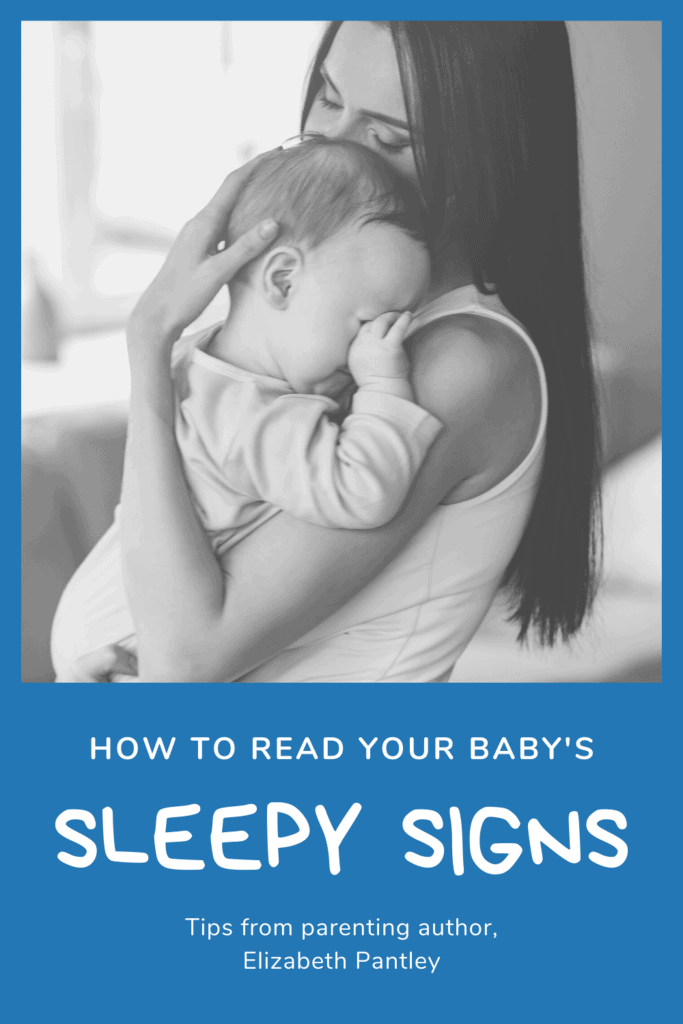
how to read your baby's sleepy signs graphic with black and white picture of mom holding a baby rubbing their eyes

How to Read Your Baby’s Sleepy Signs

Tired babies fall asleep easily, and they give signals when they are tired. If you miss the signs, your baby can become overtired and fussy. By getting to know your baby’s body language and sound signals you will master the task of reading their unique signs of fatigue. You’ll be able to put your baby to bed at exactly the right moment – and avoid battles over sleep time.

There is often a fine line between tired and over-tired, but when you pass the line your baby becomes difficult to soothe. They become too wired up to relax. At this point they will become irritable and will often fight sleep – the very thing they need most. 


This article is written by Elizabeth Pantley
For more on this topic, check out the full Sleep collection


Watch for Baby’s Sleepy Signs

Babies sleep better when you properly read their unique signs of fatigue.
(And by babies, I mean all babies.)

With infants, put them to bed every time sleep indicators show up. For older babies, watch the signs over a week to create a nap and bedtime schedule based on their personal rhythm. Pick as a guideline, and then use your child’s signals as the main cue for sleep. If you spot the signals, don’t start a lengthy routine ⎯ just get your tired little one off to bed!

 

photo of a baby boy laying on his back looking wide eyed at camera


Typical Signs of Tiredness in Babies

Your child may show one or more of these signs when tired and ready to sleep:

  • making slower motions
  • quieting down
  • losing interest in people or toys
  • rubbing eyes, ears or hair
  • staring off in the distance 
  • having a droopy jaw, chin and mouth 
  • eyes wide open; or making long slow blinks
  • becoming whiny, cranky, or fussy 
  • losing patience with toys or activities
  • having tantrums
  • yawning (of course!)
  • slumping in their seat
  • caressing a lovey or blanket
  • asking for a pacifier, bottle or to nurse


In addition to these signs of normal tiredness, babies will accelerate their signals when they become overtired. There is often a fine line between tired and over-tired, but when you pass that line your baby becomes more difficult to soothe. They get an artificial second wind and become too wired up to relax. At this point they will become very irritable and will often fight sleep – the very thing they need most. 

For more on this topic, check out the full Sleep collection


Featured Contributor: Elizabeth Pantley

Parenting educator and mother of four, Elizabeth Pantley is the author of twelve popular parenting books, including the best-selling No-Cry Solution series, and the international bestseller, The No-Cry Sleep Solution. Her books, on topics such as sleep, discipline, picky eating, separation anxiety and potty-training have been read by well over two million people in English, and have been translated into 27 different languages.
  • Website: NoCrySolution.com
  • Facebook: @ElizabethPantleyNoCryAuthor
  • Instagram: @ElizabethPantley


how to read your baby's sleepy signs graphic with black and white picture of mom holding a baby rubbing their eyes

Filed Under: Sleep

Copyright© 2026 · Brunch Pro Theme by Shay Bocks

We use cookies on our website to give you the most relevant experience by remembering your preferences and repeat visits. By clicking “Accept”, you consent to the use of ALL the cookies.
Cookie settingsCLOSE and ACCEPT
Manage consent

Privacy Overview

This website uses cookies to improve your experience while you navigate through the website. Out of these, the cookies that are categorized as necessary are stored on your browser as they are essential for the working of basic functionalities of the website. We also use third-party cookies that help us analyze and understand how you use this website. These cookies will be stored in your browser only with your consent. You also have the option to opt-out of these cookies. But opting out of some of these cookies may affect your browsing experience.
Necessary
Always Enabled
Necessary cookies are absolutely essential for the website to function properly. This category only includes cookies that ensures basic functionalities and security features of the website. These cookies do not store any personal information.
Non-necessary
Any cookies that may not be particularly necessary for the website to function and is used specifically to collect user personal data via analytics, ads, other embedded contents are termed as non-necessary cookies. It is mandatory to procure user consent prior to running these cookies on your website.
SAVE & ACCEPT