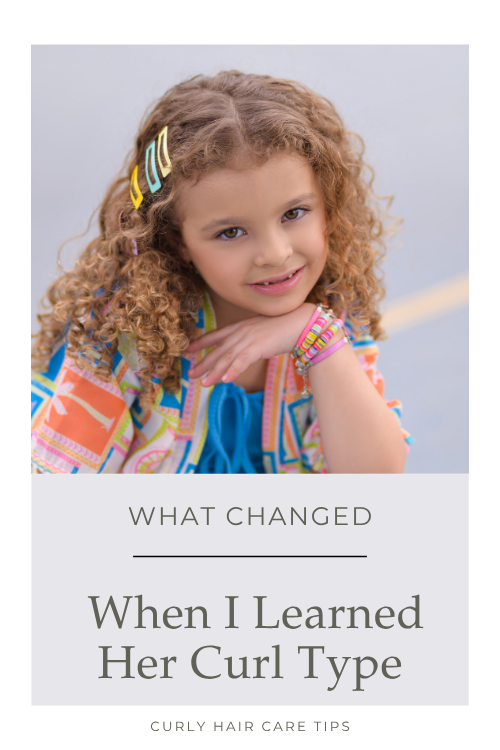
 For years, my daughter’s hair was a thing that happened to both of us every morning.
She had curls. I did not. I approached them the only way I knew how, which was the way I handle my own straight hair, and the results were exactly what you would expect. Tears, tangles, and a child who told me at seven that she wished her hair was “normal.”
That sentence is what finally made me go and learn something.
Here is what I had been getting wrong, and what actually changed once I understood what I was working with.
For more on this topic, check out the full Self Care collection
Mistake One: Treating It as One Category
I thought hair was either curly or it was not. That is not how it works.
The commonly used framework, originating with the Andre Walker system, sorts hair into four broad types, with type 2 being wavy, type 3 curly, and type 4 coily. Each divides further into A, B, and C based on how tight the pattern is.
A reference overview of these systems describes the distinctions clearly: 3A curls are loose and shiny, 3B forms springier ringlets, and 3C runs to tight corkscrews. The follicle shape itself differs between types, which is why the same technique produces different results on different heads.
Most people are also not one type. My daughter is looser at the crown and tighter underneath, which is completely normal and which explained why half her hair always behaved differently from the other half.
Learning that alone stopped me blaming the product.
Mistake Two: Buying Products for Curly Hair Without Knowing Which Kind
I had been buying whatever said curly on the bottle and wondering why nothing worked consistently.
Curl pattern is only part of the picture. Porosity, meaning how readily the hair absorbs and holds moisture, matters at least as much, as does density and strand thickness. A heavy cream that defines one child’s coils will flatten another’s waves into limp strings.
That combination is why a single label is not enough to go on. There is also a structural reason curly hair behaves differently: textured hair grows from a curved follicle and has a flattened, elliptical cross-section rather than a round one, which means natural scalp oils travel down the shaft far less easily. Tighter curls are therefore drier by default, not through neglect.
Once I understood what I was actually shopping for, I stopped grabbing whatever was nearest and started looking specifically at products for curly hair grouped by need rather than by marketing claim. Davines’ curl range was where I landed, largely because the products are organized around what curly hair actually requires rather than being one all-purpose bottle with curls printed on the label.
The bigger shift was that I stopped switching every three weeks. Curly hair takes time to respond, and I had been changing everything before anything had a chance to work.

Mistake Three: Brushing It Dry
This one still embarrasses me.
I was detangling dry hair with a regular brush, which on curls is essentially a shredding operation. The breakage I was creating was making the frizz I was then trying to fix.
Now detangling happens wet, with conditioner in, from the ends upward, with fingers or a wide-tooth comb. It takes longer. It hurts less. There is dramatically less hair in the drain.
And we stopped brushing dry entirely between washes.
Mistake Four: Drying It With a Regular Towel
Terry cloth roughs up the cuticle, which is what creates frizz on textured hair.
A cotton T-shirt or a microfiber towel, scrunching rather than rubbing, changed the result more than any product did. It costs nothing, which is annoying given how much I had already spent.
Sleeping mattered too. A satin pillowcase, or hair loosely up in a satin scrunchie, meant she woke without the tangle we used to spend twenty minutes on.
What I Did Not Expect to Learn
Here is the part that reframed the whole thing for me.
I assumed getting the technique right would fix how she felt about her hair. The research suggests it is not that simple.
A 2024 study published in the International Journal of Cosmetic Science examined how people with curly and textured hair actually relate to it. The researchers found that hair goals and perceptions were stronger predictors of what they termed hair esteem than characteristics such as hair length or curl type.
Read that again, because it took me a while. How she feels about her hair is shaped more by what she has been taught to want from it than by what her hair actually is.
Which means my commentary was part of the problem. Every time I sighed at a tangle, every time I said we needed to “do something” with it, I was teaching her that her hair was a problem to be managed.
I changed how I talked about it before I changed anything else.
Why This Matters Beyond Our Bathroom
It is worth knowing that this is not only a family issue.
Legislation exists specifically because children have faced consequences at school over natural hair. The CROWN Act was created to prohibit discrimination based on hair texture and protective styles, and research cited in its development found that Black women were 83% more likely to report being judged more harshly on their looks and 1.5 times more likely to be sent home from work because of their hair.
The bill’s federal version explicitly covers tightly coiled or curled hair, locs, cornrows, twists, braids, Bantu knots, and Afros, extending protection in schools as well as workplaces.
Knowing that context changed how seriously I took a seven-year-old’s offhand comment about wanting normal hair.
Where We Are Now
Mornings are calmer, though not saintly. She has opinions about her products, which she chooses herself.
The practical knowledge helped enormously. Wet detangling, the right products, no terry cloth, satin at night.
But the thing that actually changed was language. Her hair is not something we fix. It is something she has.
That took longer to learn than the curl type did, and it mattered considerably more.
For more on this topic, check out the full Self Care collection