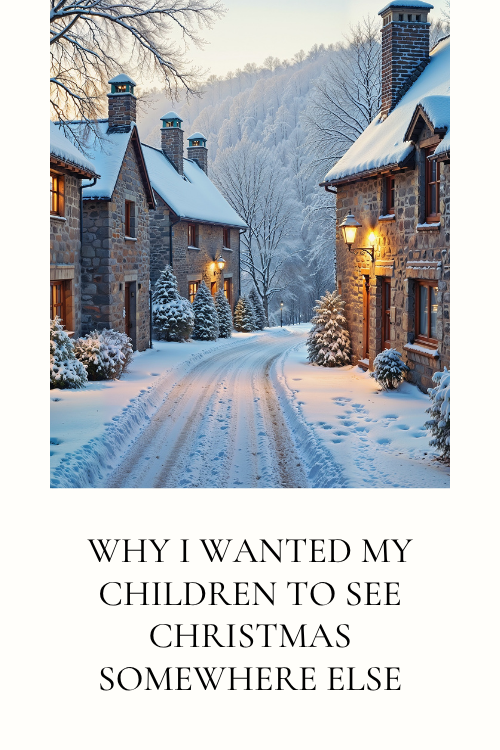
 I did not plan this trip because our Christmases were bad. They were lovely.
I planned it because I had started to notice something in my kids that I did not love. By early November they were already talking about what they were getting. Not what we were doing, or who we were seeing. What they were getting.
That is not a character flaw. It is a completely normal response to the environment we build around them every December. But I wanted them to see that this holiday looks different somewhere else, and that the version we run is a choice rather than the only way it is done.
For more on this topic, check out the full Happy Holidays collection
What I Was Actually Hoping For
I want to be honest about my expectations, because they were not entirely realistic.
I hoped they would come home less focused on gifts. I hoped they would notice that families elsewhere celebrate with far less and enjoy it just as much. I hoped, quietly, for a personality transplant delivered by exposure to cobblestones.
The research on experiences versus things did give me some confidence. Work published in the Journal of Consumer Research found that experiential gifts strengthen relationships more than material ones, partly because experiences evoke stronger emotion in the person receiving them.
But here is the finding that genuinely changed how I approached the trip, and I wish more parents knew it.
A study of children aged three to seventeen found that younger children actually derive more happiness from material gifts than from experiences. The advantage of experiences increases with age, and teenagers get the most from them. The reason is memory. For an experience to deliver lasting happiness, a child has to be able to recall it in detail afterward.
That reframed things for me completely. My older ones were going to get something out of this that my younger ones simply could not, developmentally, hold onto.
So I stopped expecting the same thing from each of them.
Why We Chose Holiday River Cruises Over One City
The practical planning question was where, and I overthought it for weeks.
What I wanted was contrast. Not one place, but several, so they could see that even neighboring countries do this differently. Germany is not Austria is not the Netherlands.
Doing that by train and hotel with children is a logistical undertaking I was not equal to that particular year. Which is how we ended up looking at holiday river cruises in the first place, and specifically at Celebrity Cruises’ seasonal December sailings through the European markets. The practical appeal was immediately obvious: you unpack once, and the next market arrives while everyone is asleep.
The unpacking-once part matters more with kids than I can adequately explain. Nobody is dragging a suitcase through a train station in the cold. Nobody is losing a coat in a fourth hotel lobby.
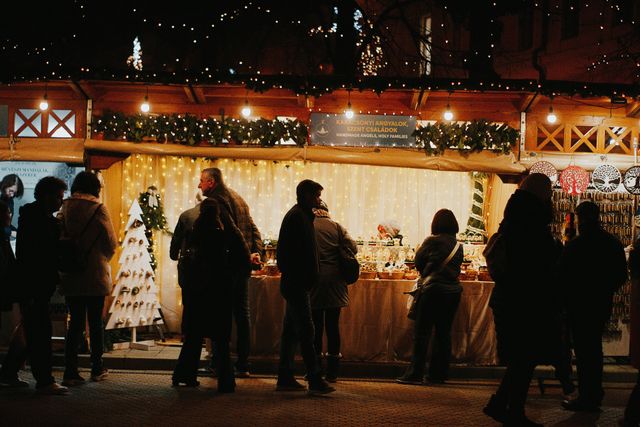
And the markets themselves did what I hoped. Wooden stalls. Food you eat standing up. Ornaments carved by the person selling them. Very little of it plastic, very little of it packaged, none of it advertised at them beforehand.
What They Actually Noticed
Almost none of what I planned for.
They did not have a revelation about consumerism. Nobody said anything profound about tradition.
What they noticed was that the markets smelled different. That children were out late with their families on a weeknight. That the hot chocolate was thicker. That a man was carving something by hand and it took him ages.
That last one held my youngest’s attention for a solid twenty minutes, which is roughly nineteen minutes longer than anything manages at home.
They noticed people were outside, together, in the cold, apparently entirely by choice. That was the observation that kept coming up again afterward.
I had been aiming for a lesson. What they took was atmosphere. On reflection, atmosphere is probably the more durable thing anyway.
What Actually Seemed to Stick
Two things, both smaller than I expected and both better.
The first was gratitude, though it arrived sideways rather than on cue. Research on experiential gifts suggests they tend to feel more autonomy supportive and to generate more gratitude than material ones, particularly when the recipient understands they were given out of love. My kids did not thank me for the trip in the moment. They brought it up months later, repeatedly, which I have decided counts.
The second was a shift in what they asked for. Not eliminated, just reduced. Some of that is probably my own behavior changing alongside theirs, and the research suggests that matters more than I had realized. A large study of nearly two thousand parent-child pairs found that higher parental materialism is associated with stronger materialistic values in children and with weaker family relationships.
Which is a slightly uncomfortable thing to sit with. My kids were reflecting something back at me.
What I Would Tell Another Parent
Do not expect the lesson to land the way you scripted it. It will not. They will remember the hot chocolate.
Take photographs, especially for the younger ones. The research on memory is clear that little kids need something to anchor a recollection, and photos genuinely help them keep hold of an experience they would otherwise lose.
Adjust your expectations by age. A fifteen-year-old and a five-year-old are not getting the same thing out of this, and pretending otherwise sets everyone up for disappointment.
And you do not have to leave the country. The actual mechanism is showing children that our version of a holiday is one version among many. A different neighborhood, a friend’s family celebration, a cultural festival in your own city can do a version of the same work.
We went far because we could that year. The point was never the distance.
It was that they came home understanding Christmas is something people make, differently, everywhere. And that we get to decide what ours looks like.
For more on this topic, check out the full Happy Holidays collection