 Ever watched a child go quiet when a grown-up falls apart?
It happens quickly. One day a parent picks up drinking again, vanishes for the weekend, or walks through the door like a stranger. And somewhere in that house, a seven-year-old quietly blames themselves because they laughed too loudly at breakfast.
Kids are hardwired for understanding. When parents fail them because of addiction, depression or falling back into bad patterns children will create their own story to fill in the blanks…
Themselves.
The good news is that belief can be changed. By using the proper words, said frequently enough, a child can learn that adult issues are adults’ problems.
Here is how to do it.
For more on this topic, check out the full Child Behavior collection
What You’ll Take Away:
- Why Kids Blame Themselves First
- How Relapse Prevention Protects Children Too
- The Words That Actually Land
- Small Habits That Rebuild Safety
- When To Bring In Outside Help
Why Kids Blame Themselves First
Young children believe the world centers around them. This is not selfishness. It just comes with a developing brain.
That’s why when something goes awry at home, kids look for a nearby source of blame. And the blame is always… them.
This shows up in ways adults miss all the time:
- Becoming “perfect” overnight to keep the peace
- Taking on chores and caretaking far beyond their age
- Going silent about things that clearly upset them
- Stomach aches, headaches and trouble sleeping
The magnitude of this is larger than most people understand. Studies indicate that 1 in 4 children in the US live in a household with a parent who struggles with substance use disorder. Millions of kids silently shouldering guilt that isn’t theirs to shoulder.

How Relapse Prevention Protects Children Too
Relapse prevention is often discussed as if it’s something the adult will do by themselves. Meetings. Triggers. Coping plans. Accountability calls.
But it is also a child protection strategy.
When there’s a legitimate relapse prevention plan in place and the family understands the basics of that plan, kids aren’t left guessing. They know what a warning sign is, they know who to go to, and they know what to expect after that. Recovery teams and family programs at an Illinois rehab center often incorporate children into that plan intentionally. That’s because a child who understands the relapse prevention plan is a child who stops blaming themselves when those moments occur.
Setbacks occur. Between 40% and 60% of people who receive treatment for a substance use disorder will relapse at some point. This is similar to rates of chronic diseases such as asthma or hypertension.
Here is why that number matters for a child:
Unless someone tells them ahead of time, a relapse appears to be evidence that the child wasn’t good enough to maintain the parent’s wellness. When it’s explained in advance, a relapse seems like what it is…..a medical condition flaring up.
Same event. Completely different meaning.
The Words That Actually Land
Adults tend to say “it’s not your fault” once and assume the message stuck.
It rarely does.
Kids need you to repeat yourself. Tell them simple stuff when you’re not in the crisis. Use short sentences. And be truthful. Children know when you’re feeding them a line.
Phrases that work well:
- “This is a grown-up problem, and grown-ups are working on it.”
- “You did not cause it. You cannot cure it. You cannot control it.”
- “Nothing you did or said made this happen.”
- “It is okay to love someone and still be angry at them.”
- “Your job is to be a kid. That is it.”
Phrases to steer clear of
- “Be good and Daddy will get better.” (Makes the child responsible.)
- “Don’t tell anyone.” (Teaches secrecy and shame.)
- “Everything is fine.” (Contradicts what they can plainly see.)
- “You’re the man of the house now.” (Hands a child an adult role.)
Do you see the pattern? Every constructive statement shifts responsibility away from the child. Every destructive one subtly shifts it onto them.
Small Habits That Rebuild Safety
Words are important, but patterns are stronger. A child who hears comforting phrases while living in a turbulent household will remember the turbulence, not the phrases.
Predictability is the antidote.
That means the same bedtime and wakeup. The same school run. The same Saturday morning pancakes. Tediously predictable things. It gives your nervous system the news that the ground is stable again.
A few habits that do the heavy lifting:
- Say feelings aloud. “You look worried today” opens the door for the child to discuss.
- Have one trusted adult on standby. Grandparent, teacher, coach or neighbour who knows whats going on.
- Maintain a normal childhood. Don’t let football practice, sleepovers and birthday parties vanish because of an adult issue.
- Answer questions honestly, but keep it age-appropriate. Honest does not mean detailed.
There’s another reason to protect these routines. Kids in homes with parental addiction have a greater chance of facing issues of their own down the road. Consistent, predictable care is one of the best ways to help prevent that.
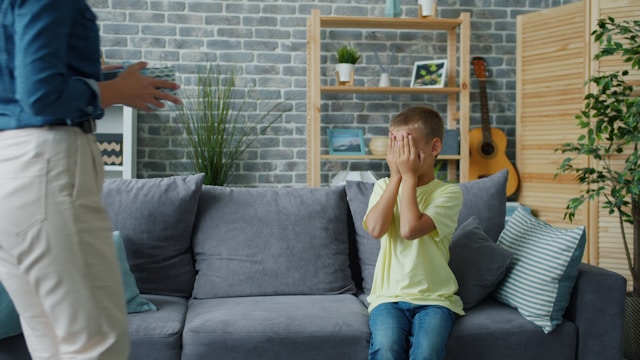
When To Bring In Outside Help
Certain indicators suggest a child requires additional assistance beyond what a family can offer independently.
Watch for:
- Slipping grades or refusing school
- Aggression or withdrawal that lasts for weeks
- Talk of being a burden or being to blame
- Sleep problems, appetite changes or frequent physical complaints
- Trying to take care of the struggling adult
The school counselor is often the easiest first door to knock on. Family therapy, kids support groups and kids only programs specifically for children of addiction all work. None of them require the adult to be fully recovered first.
Don’t wait until your house is “fixed” to get help for your child. You can get help NOW.
Tying It All Together
Kids are not blank slates. They are actors. They will create a narrative with what they have to work with.
Leave the gaps unfilled, and they write themselves in as the villain.
So fill the gaps:
- Say plainly that the problem is a grown-up problem
- Explain relapse prevention in words a child can follow
- Keep routines steady even when the adults are not
- Give them one safe adult outside the home
- Bring in professional support early, not eventually
None of this needs perfect parents or perfect recoveries. It just needs honesty, repetition and some scaffolding.
A child that carries the weight of thinking they caused an adults illness has that for 30+ years. A child that you tell the truth to, repeatedly, can lay it down.
That is the whole job.
For more on this topic, check out the full Child Behavior collection