According to WebMD.com, “Sensory Processing Disorder is a condition in which the brain has trouble receiving and responding to information that comes in through the senses.” I have read studies that say anywhere from 1 in 20 kids, to as many as 1-6 kids, struggle with SPD. But no matter the correct number, it seems to be growing. Whether by diagnosis or by educating parents to have their children tested, it seems SPD affects a lot of people around us. Continue reading below for an in-depth look into the symptoms of SPD.
Written and Created by Karissa Tunis
For more on this topic, check out the full Mental Health collection
What are the Symptoms of Sensory Processing?
It’s important to remember that every child will respond differently, and some days they will be more sensitive than others. If you suspect your child may be dealing with SPD, please get them tested and help as soon as possible!
Even if your child does not deal with SPD, it is beneficial to know these traits so that incase a child ever comes into your home that is dealing with any of these symptoms, you know how to create a more pleasurable environment for them.
Some children may experience only one or two of their senses being hyper or hypo sensitive, while other’s may experience a whole combination.
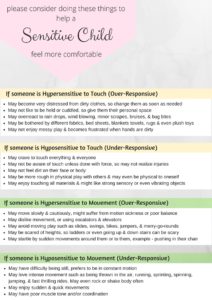
Please understand that below does not nearly include all of the possible symptoms, and I know that there are more in-depth versions. But here are the basics that I have researched. Above is also a link to a free printable that includes the points mentioned below. It may be a good idea to print that out as a reminder for everyone in your house on how to respond to a more sensitive guest.
The senses I discuss below are Touch, Movement, Sound, Oral, Smell and Visual
Learn how to Recognize Separation Anxiety, how to Calm Your Child During an Anxiety Attack, how to Identify Curiosity or Anxiety, and how to Help Your Child Feel Safe
SPD Symptoms – Touch
Hypersensitivity to Touch (Over-Responsive), They May…
- become very distressed from a dirty diaper or dirty clothes, so change them as soon as needed
- not like to be held or cuddled, and can become fearful or anxious with light or unexpected touch, so give them their personal space
- overreact to rain drops, wind blowing, water from a shower or sprinkler, minor scrapes, cuts, bruises, bug bites, these may feel like torture to their skin
- be bothered by clothing seams and/or different fabrics, hats, mittens, belts, bed sheets, blankets, towels, rugs, plush toys; certain textiles may feel bumpy or prickly to them and can even be painful on their skin
- not enjoy messy play and becomes frustrated when hands are dirty
Hyposensitvity to Touch (Under-Responsive), They May…
- crave to touch everything and everyone
- not be aware of touch unless done with force, so may not realize injuries, cuts, scrapes or bruises
- not feel dirt on the their face or body
- be more rough in physical play with other children, and may even be more physical to oneself
- enjoy touching all textiles, materials, and might like strong sensory or even vibrating objects
SPD Symptoms – Movement
Hypersensitivity to Movement (Over-Responsive), They May…
- move slowly and cautiously, and might even suffer from motion sickness and poor balance
- dislike moving such as escalators and elevators, so you could consider encouraging them to sit if safely possible, and might avoid moving play such as slides, swings, bikes, jumpers, and merry-go-rounds
- also be scarred of heights, so ladders or even going up and down stairs can be scary
- be startled by sudden movements around them or to them such as pushing in their chair
Hyposensitivity to Movement (Under-Responsive), They May…
- have difficulty being still, prefers to be in constant motion
- love intense movement such as being thrown in the air, running, sprinting, spinning, jumping, and fast thrilling rides, may even rock or shake body often
- enjoy sudden and quick movements
- have poor muscle tone and/or coordination
SPD Symptoms – Sound
Hypersensitivity to Sound (Over-Responsive), They May…
- be distracted by sounds not normally noticed or even heard by others such as humming, fans, ticking, far off airplanes or other vehicles
- be fearful of loud and/or sudden noises such as flushing toilets (especially in public restrooms), vacuums, hair-dryers, or a dog barking
- not like loud public places such as playgrounds, amusement parks, movie theaters, carnivals, parades, and concerts
- be bothered by squeaky shoes, background noise, someone singing, tapping, and even the tone of someone’s voice
- often cover ears and even cry from noises
Hyposensitivity to Sound (Under-Responsive), They May…
- be oblivious to certain sounds
- not respond to verbal cues, might not realize when name is called
- love making noise or even talking to self
- like loud music & TV
- have difficulty remembering or understanding what was said
SPD Symptoms – Oral
Hypersensitivity to Oral Input (Over-Responsive), They May…
- be very sensitive to certain food textures and tastes, might even refuse to lick envelopes and stickers
- gag, choke, or even vomit often
- have difficulty sucking, chewing or swallowing – especially as a baby
- prefer only hot or cold foods
- dislike toothpaste, mouthwash, brushing teeth and even going to the dentist
Hyposensitivity to Oral Input (Under-Responsive), They May…
- be always putting objects in mouth, and might repeatedly chew or suck on hair, fingers, and shirt
- have excessive drooling during, and past, the teething stage
- lick, taste, or even chew non edible objects
- prefer strong and intense flavors, otherwise majority of food may taste similar and bland
- love vibrating chew toys, toothbrushes, and even trips to the dentist
SPD Symptoms – Smell
Hypersensitivity to Smells (Over-Responsive), They May…
- be bothered by or dislike smells that typically would go unnoticed.
- talk about how funny things smell
- refuse certain foods based on their smell
- be irritated by perfume, cologne, household, baking, or cleaning smells
- stay away from certain houses or businesses because of the way they smell
Hyposensitivity to Smells (Under-Responsive), They May…
- have difficulty smelling nice or even unpleasant odors (be careful with chemicals around the house)
- not notice bad tastes (be careful with spoiled foods or chemicals)
- not be able to smell scratch n’ sniff stickers
- want to excessively smell objects or people
SPD Symptoms – Visual
Hypersensitivity to Visual Input (Over-Responsive), They May…
- be sensitive to bright or excessively dim lights; might squint, cover eyes, cry, and even get headaches from the light
- have difficulty keeping eyes focused on a task or activity for a normal or extended amount of time
- be easily distracted by other visual stimulants such as movements, colors, decorations etc.
- rub eyes, have watery eyes, or even complain of headaches after reading or watching TV
- avoid eye contact
Hyposensitivity to Visual Input (Under-Responsive), They May…
- have difficulty with tracking, differentiating between similar objects, or even with perception
- focus on the details or patterns instead of the “big picture”
- have a hard time searching for items, finding a toy in a toy bin, looking for something in a drawer or on a shelf
- have difficulty controlling eye movement following an object
- lose place while reading or doing math problems, have trouble with jigsaw puzzles, and cutting or tracing along a line
Please Remember
Again, no two children are the same, and no child is the same every day. It’s important to remember that when working with a child that has SPD, you need to stay patient, know their “triggers” or struggles, offer options, and sometimes even think outside the box. Please do not force them to do anything that is uncomfortable, because to them this can be very physically painful.
There are so many incredible resources, doctors, therapy options, and products designed specifically for children with SPD. So the sooner you can get a diagnosis and some help, the sooner you can try to move on with your life – just maybe in a new way implementing some new techniques that make your little one more comfortable.
For more on this topic, check out the full Mental Health collection

Co-Owner: Karissa Tunis
Karissa Tunis is the co-owner of both the parenting website Adore Them and the family event company Milestone Family Expos. Through these ventures she is able to share inspiring, heartfelt insight with large audiences within local communities and across the country! Her knack for all-things-organization allows her to balance content creation, brand partnerships, and event planning without losing sight of what she wants for her own family. Despite her busy schedule, Karissa also makes it a priority to spend quality time with her husband and three children. You will often find her volunteering at her children’s schools, cheering them on from the soccer sidelines, or enjoying the great sites of Charleston, SC with her family.
Contact: Karissa@AdoreThem.com