
This article is written by Katie Strohecker
For more on this topic, check out the full Pregnancy Through Postpartum collection
My First Birth Story
I was 28 when I became pregnant with my daughter. My pregnancy was uneventful. We had taken the childbirth classes offered at our local hospital and were feeling prepared. Little did we know, these classes only really prepared you for a natural, uncomplicated delivery.
Early one morning, after my husband already left for work and 3 weeks before my due date, my water broke in the shower. It wasn’t one of those movie moments when the woman looks down at a pool of water on the floor. I kept drying my legs when I got out of the shower and then they would be wet again. I didn’t know if this was it, but I knew something was up. So my husband turned around and headed back home and we went into the hospital to get checked.
Pitocin Induction
My water had indeed broken, but I wasn’t having any contractions. Childbirth class didn’t prepare us for what happened next. My OBGYN started me on Pitocin, a drug used to jump start labor. (Shari also had a Pitocin induction, you can read about her experience here as well: An Induction Birth Story) Apparently once your water breaks, they really want you to deliver within 24 hours in order to minimize infection for both mom and baby. That seemed reasonable to me at the time.
I labored for 11 hours without any pain management and I was only 4 centimeters dilated. When offered, I happily accepted an Epidural because they thought it would relax me and I would dilate to 10 cm more quickly. I didn’t. It was another 11 hours before I was ready to start pushing. I pushed for 3 hours and was exhausted.
I couldn’t feel anything because of my Epidural and my pushes were not productive. Baby's heart rate was unstable. My doctor offered to do a cesarean section because she felt like I was just too tired to push the baby out, and we were at the 24 hour mark since my water broke. I obliged.
Ending Up with a Cesarean Section
Another thing childbirth class did not prepare us for was if you end up in a cesarean section delivery. I had watched TLC's A Baby Story many times, so I knew a bit about what to expect, but going through it yourself is very different. Since I had pushed for so long, the baby was in the birth canal and had to be manipulated back up into the uterus for delivery. Other than that, it was a routine cesarean section. We had a beautiful baby girl on a unseasonably hot day in March.
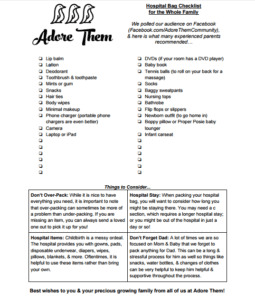
Submit your email to receive instant access to this FREE printable!
My Second Birth Experience – Trying for a VBAC
Fast forward three years, I found myself pregnant again with my second child. This time we were having a boy. It took me a while to wrap my head around that one…a boy. What was I going to do with a boy? I knew nothing about trucks, tractors, or dirt. What I did know was I wanted to have a vaginal delivery after cesarean section (vbac). I was motivated to do it naturally without any pain medicine, and I wanted the assistance of a birth doula.
(Note: every birth experience can be so different! Read Karissa’s article for her experiences: 3 Births, 3 Different Experiences)
Looking into Hiring a Doula for My VBAC
Have you heard of a birth doula? My sister-in-law had hired a doula to assist her third birth and raved about the experience. Even her husband claimed how fantastic the experience was for him as well. So, I started interviewing birth doulas. There were many things to consider. For me, I was concerned most with personality compatibility and the fees (since we were paying out of pocket).
Helpful Advice from a Doula
One really valuable conversation with one of the doulas I interviewed, actually led me to switch OBGYN practices at 36 weeks pregnant. Scary, I know, but I was not being supported at the previous OBGYN practice with regard to my wishes for a vbac.
This is important! If your doctor doesn’t support you, it can be very difficult to reach your intended goal. I was determined and feeling good. By 36 weeks, I had hired a doula and was getting to know the midwives at my new practice. I was also going to be delivering at a different hospital than my first birth. Thankfully, I had visited a friend there before so I had some familiarity.
Adjusting our Birth Plan and Hoping for a VBAC
After meeting with our doula a few times, my husband and I felt prepared for a whole different birth experience. One thing I loved about our doula, Wendy, was how she would teach my husband how to help me. She would coach me but also empower him to help me in the most effective ways. She was clear that she would not be making any medical decision for me but would give me all the facts and allow me to decide.
In the back of my mind, I was a little worried I would end up in a cesarean section a second time, but she assured me I could do this. She had assisted hundreds of births before mine and only one had ended in a cesarean section. She was a great encouragement and helped to put my mind at ease. I needed to feel I could do this and be successful going into it, just like a team needs a pep rally before a game.
VBAC Labor and Delivery Experience
At 38 weeks and after pushing my 3 year old daughter a mile in the stroller one June afternoon, I went into labor. It started slow, around 4 pm. I told my husband when he got home that I was having some contractions. We went about our evening…had dinner, put our daughter to bed, and then went to bed ourselves. At about 1 am I couldn’t lay in bed any longer. So I got up and drew a bath. I sat in the bath breathing through the contractions and letting my husband sleep, because I knew I needed him to be somewhat rested.
By 3 am, I had woken him up and called Wendy to come over. Once she had arrived, she assessed my contractions which were every 3 minutes or so. She had my husband call the doctor and let them know we were heading into the hospital soon. By 5 am, my mom had arrived to stay with my daughter and we were heading to the hospital.
Arriving at the Hospital to Deliver My Baby
Once we were settled into the labor and delivery room, things were in full gear. I was in transition and by the time the midwife checked me, I was already 9 centimeters! Between Wendy and my husband, I was swaying holding onto him and she was putting pressure where I needed it on my hips to help relieve some of the pain of each contraction. It was time to push. I had really wanted to be able to push up on all fours, but the baby’s heart rate dropped each time I tried. Sadly, I was stuck on my back, the most unideal position. Making the best of it, I pushed…but he {baby} wasn’t moving down. The midwife called for the doctor on-call to pay me a visit, which I knew was not a good sign.
A VBAC Success Story!
Things were not going as I had planned, but my husband and Wendy kept encouraging me to stay positive. Later, I learned from my husband that he had overheard the doctor tell a nurse to get the operating room ready. I was scared, but I wasn’t going to let it get the best of me. I used my fear to drive me. The doctor signaled the nurse and said to me, 'You’re making a believer out of me!' I was making progress and baby's head was crowning.
Moments later, I had a beautiful baby boy on my chest. He was whisked away shortly after that for some breathing difficulty and had a short stay in the NICU but was released later that evening. I had done it! It was not without some battle scars (tearing), but that would heal in due time.
A happy ending.
Read more pregnancy and birth stories:
3 Kids, 3 Very Different Birth Experiences
My Home Birth, and Why I Loved It
For more on this topic, check out the full Pregnancy Through Postpartum collection
 Featured Contributor: Katie Strohecker
-
-
- Website: milestonefamilyexpos.com
- Facebook: @pafamilyexpo @lancasterbabyshower
- Instagram: @milestone_family_expos/
-












 Purchasing baby food at the grocery store is very convenient, but making it yourself is much easier than you think! It also allows you to control everything that your little one is ingesting. So, I encourage you to give this simple baby food recipe a try, or use it as a base and get creative with your own ingredients!…

 Developmental milestones are behaviors or physical skills seen in infants and children as they grow and develop. Rolling over, crawling, walking, and talking are all considered milestones. The milestones and stages of development are different for each age range and can vary within the set development guidelines quite a bit.
 MILESTONES: WHAT ARE THEY & WHY THEY ARE IMPORTANT?